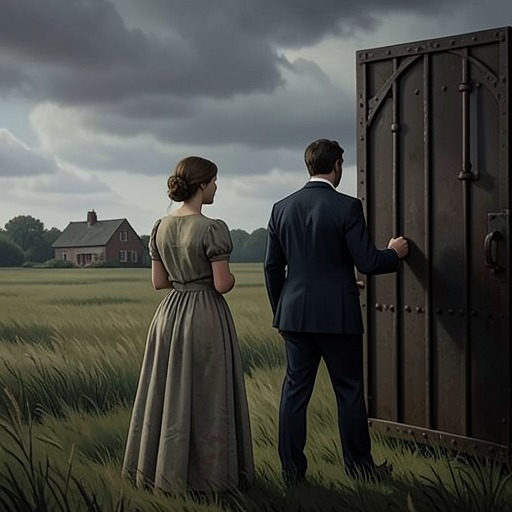
Clifford’s proposal that Connie have a child by another man
Lady Chatterley's LoverClifford Chatterley’s proposal that Connie Chatterley have a child by another man turns the problem of an heir into a test of what marriage and parenthood mean to them. He imagines the child being raised at Wragby as belonging to the couple and the place, while Connie hears an impersonal plan that subordinates both the child and her own desires to continuity. His argument treats sexual relationships as temporary and marriage as the lasting bond; its practical permissiveness therefore exposes, rather than resolves, the difference between their understandings of intimacy.
Setting and the desire for an heir
The discussion takes place in the wood, a landscape associated with the past as well as the Chatterley family’s claim to preserve it. Clifford reflects that not having a son weighs on him especially when he comes there. He regards the wood as older than his family, yet insists that the family has preserved it and that, without such stewardship, it would have disappeared like the rest of the forest. The setting makes the missing heir part of a larger concern about inheritance: for Clifford, a child would continue not only the family but also its connection to the place and to an older England.
He describes a son as a link in a chain. Connie is uneasy with that image, sensing the impersonality of his wish, but she does not challenge it directly. Her apology that they cannot have a son leads Clifford to propose that she have a child with another man. If the child were brought up at Wragby, he reasons, it could be regarded as theirs and carry the family’s future forward. He says he does not believe intensely in fatherhood, placing greater weight on the child’s upbringing and incorporation into their shared household than on biological paternity.
Clifford’s theory of marriage and sex
Clifford presents the proposal as an extension of a broader theory of married life. He distinguishes lasting companionship from occasional sexual relationships, which he regards as passing connections that need not threaten a marriage. He invokes Connie’s earlier lover in Germany as an example of an affair whose importance, in his view, has faded. The enduring reality, he argues, is the couple’s long life together: their habits, accumulated intimacy, and gradual adjustment to one another.
His reasoning makes marriage a continuing structure that can absorb experiences outside it. He compares arranging for sex to dealing with a practical necessity and argues that a person might seek an affair if the absence of sex threatened an integrated life, or seek a child if childlessness threatened that same sense of wholeness. Such choices, in his account, should serve a harmonious life built over time rather than become ends in themselves. He proposes that he and Connie adapt to their circumstances together, weaving any such accommodation into their shared life.
This argument is both accommodating and controlling. Clifford allows for Connie to have a child by someone else, and says he would rather not know the man’s identity. Yet the arrangement is defined by its usefulness to their marriage and household. Connie recognizes the theoretical coherence of his case but hesitates when she considers continuing to shape her entire future around the life she has built with Clifford. She thinks of the affair as an excursion from that marriage and wonders whether an excursion must always end in a return home. The image captures her uncertainty without resolving it in Clifford’s favor.
Connie’s response and the proposal’s limits
Connie asks whether the other man matters. Clifford answers by minimizing the significance of sexual connections and emphasizing the couple’s established companionship. His distinction leaves little room for the emotional meaning that an affair or a child might have for Connie. She listens with wonder and fear, and is overwhelmed by his reasoning, but her hesitation shows that intellectual agreement does not settle what she wants or what she can accept in practice.
The proposed child is especially revealing in the way Clifford speaks of it as an arrangement for the couple and Wragby. Connie’s immediate perception is that the child, her child, becomes an impersonal object in his account. His desire for an heir is thus not identical to a desire for fatherhood: he stresses continuity and rearing while disclaiming a strong investment in biological paternity. The proposal offers a solution to childlessness, but it does not answer Connie’s concern about whether her own life and the child’s individuality would be absorbed into the estate’s future.
Later conflict and narrative significance
The proposal belongs to a wider history of marital estrangement in which practical arrangements cannot guarantee emotional agreement. Later, Clifford tells Connie that he has consulted a lawyer about divorce, marking a new development in the couple’s conflict. When scandal surrounding Oliver Mellors reaches Wragby, Clifford’s response is to offer Connie a stay away from the surrounding gossip; the correspondence also reveals that Connie’s connection with Mellors has become publicly suspected and legally consequential. These later events do not make the earlier proposal a simple prediction of what follows. They instead sharpen its central tension: Clifford can imagine accommodating an outside sexual connection in principle, but the reality of Connie’s independent attachment unsettles the terms on which he expected their marriage to endure.
When Connie eventually asks Clifford to divorce her, he refuses, even after she suggests that Duncan Forbes could serve as a pretext without naming the real relationship. His refusal makes the limit of his earlier flexibility plain. He had treated an outside relationship as potentially subordinate to the couple’s shared life; when Connie seeks to leave that life, he insists on his own inclination rather than consenting to dissolve the marriage. The proposal therefore stands as more than an unconventional answer to the lack of an heir. It exposes the gap between Clifford’s idea of marriage as an enduring arrangement that can absorb outside necessities and Connie’s need to determine what her relationships and future mean for herself.